AWS Cloud Security Architecture & SOC 2 Compliance
Led the security transformation of a production AWS environment into a SOC 2–aligned platform — IAM redesign, centralized secrets, continuous monitoring, stronger incident response, and ~30–40% lower cloud spend.
Key highlights
- Drove a legacy AWS environment through a full security transformation to SOC 2 alignment — identity, secrets, monitoring, and response.
- Redesigned IAM around least privilege, cutting unnecessary permissions by ~70% with MFA, role separation, and access reviews.
- Centralized secrets in Secrets Manager and key management in KMS, moving to runtime secret retrieval with encryption everywhere.
- Stood up continuous threat detection and compliance monitoring (GuardDuty, Inspector, Config, CloudTrail) — ~70% less audit-prep effort.
- Led incident investigation, root-cause analysis, and hardening — turning a security event into durable detection and control improvements.
- Reduced monthly AWS spend by ~30–40% through rightsizing and monitoring, without weakening security or availability.
Overview
Led the security modernization of a production AWS environment by implementing a secure cloud architecture aligned with SOC 2 requirements.
The initiative focused on strengthening identity controls, improving visibility into cloud activity, centralizing secrets management, and establishing continuous monitoring and compliance processes — while reducing operational overhead. The result was a more secure, auditable, and operationally mature cloud platform capable of supporting both engineering and compliance requirements.
This was a transformation, not a checklist — taking a legacy environment and re-shaping it stage by stage:
Legacy AWS Environment
        ↓
Security Review
        ↓
IAM Redesign
        ↓
Secrets Centralization
        ↓
Continuous Monitoring
        ↓
SOC 2 Alignment
        ↓
Incident Response Improvements
        ↓
Cost Optimization
Business challenge
The environment had grown faster than its security model. The pressures that triggered the work:
- Privilege creep — broad, accumulated IAM permissions with no clear ownership.
- Audit preparation effort — evidence gathered manually, slowly, and repeatedly.
- Limited monitoring visibility — little signal on threats or configuration drift.
- Decentralized secrets — credentials scattered across code, config, and environments.
- Rising cloud costs — spend growing faster than usage justified.
- Compliance readiness — no repeatable path to satisfy SOC 2 controls.
The goal was a secure, auditable, and scalable platform that met SOC 2 requirements while keeping engineering friction low.
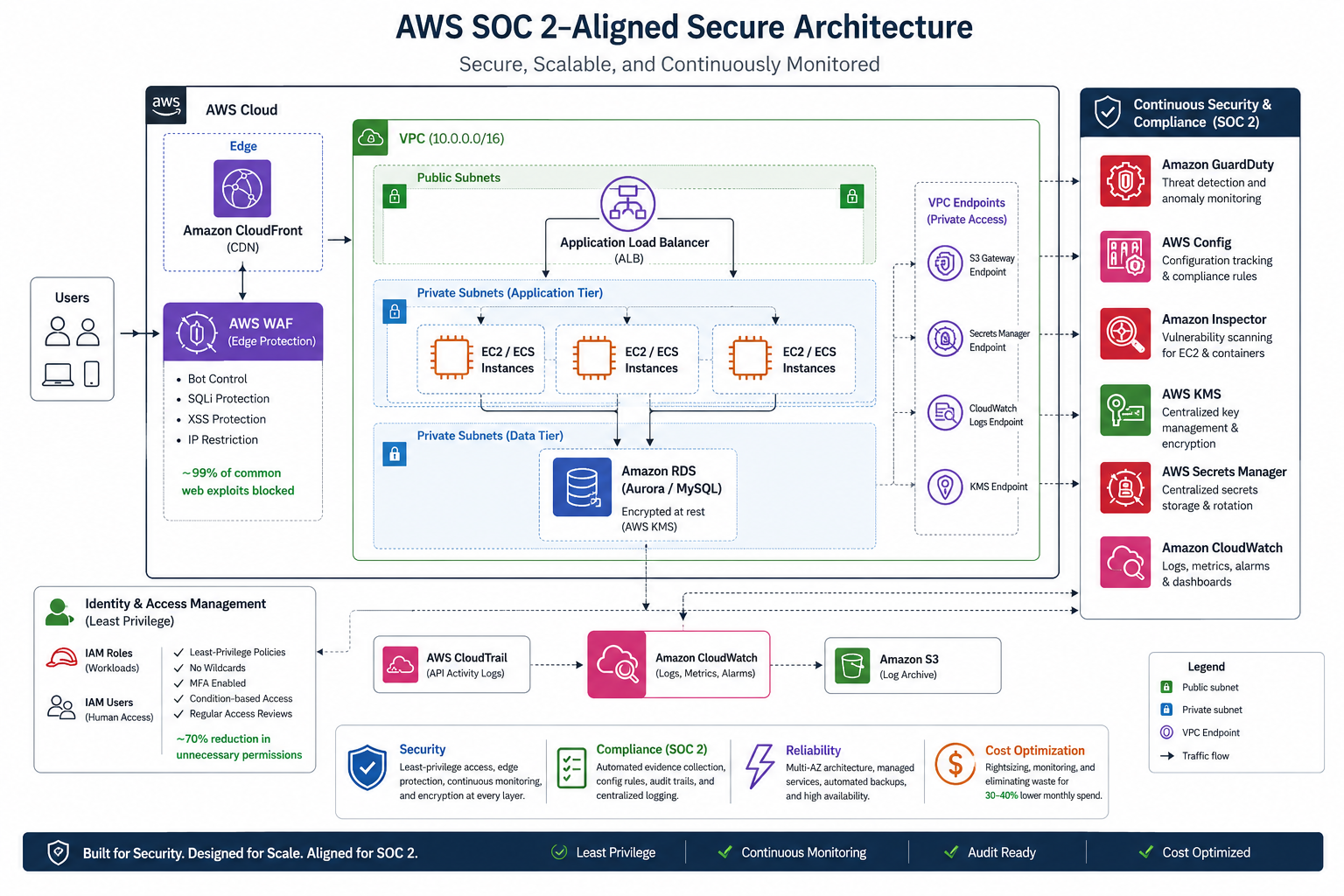
Architecture
The architecture follows a layered security model:
- CloudFront + WAF edge protection in front of all application traffic.
- A private application architecture with workloads isolated from direct internet exposure.
- Segmented workloads across controlled network tiers.
- An encrypted data layer protected by network isolation and managed keys.
- A continuous monitoring plane that constantly validates the environment against security and compliance baselines.
Each layer exists to shrink the attack surface and produce the evidence SOC 2 expects — by design, not after the fact.
Security improvements
Identity & access management
The redesign started with identity. Rebuilt the IAM model around least privilege — removing wildcard and standing permissions, enforcing MFA, separating human, service, and automation roles, and instituting regular access reviews. The outcome: roughly a 70% reduction in unnecessary permissions and an access model that is easy to reason about and defend in an audit.
Secrets & encryption
Pulled credentials out of code, config, and environment files and into AWS Secrets Manager, with runtime secret retrieval via IAM authorization. Centralized encryption keys in AWS KMS so data is protected at rest and in transit with managed rotation. Secret sprawl became a single, access-controlled, rotatable source of truth.
Threat detection
Established continuous detection with GuardDuty, Inspector, and AWS Config — surfacing suspicious activity, workload vulnerabilities, and configuration drift automatically. The shift was from periodic, manual checks to always-on signal feeding operational workflows, so issues are caught and remediated quickly.
Compliance engineering
A core part of the work was mapping technical controls directly to SOC 2 requirements so that compliance is continuous rather than a quarterly scramble:
- Access controls — least-privilege IAM, MFA enforcement, role separation, documented access reviews.
- Logging — centralized CloudTrail activity logging across the environment.
- Evidence collection — automated configuration records, audit logs, and security findings retained for auditors.
- Continuous compliance monitoring — Config rules and dashboards that flag non-compliant resources as they appear.
Together these substantially reduced manual audit-preparation effort — on the order of 70% — and kept the environment audit-ready between assessment windows.
Incident response
One of the strongest parts of the project was maturing how the organization responds to security events. Led a production security incident end to end:
- Investigation — scoped the activity and analyzed logs to understand what happened.
- Root-cause analysis — identified the underlying weakness rather than just the symptom.
- Hardening improvements — closed the gap and tightened the surrounding access controls.
- Monitoring enhancements — added detection and alerting so the same class of issue surfaces immediately if it recurs.
The incident became a forcing function: response procedures, detection coverage, and access controls all came out stronger.
Cost optimization
Security work ran alongside cost discipline. Through resource rightsizing, idle-resource cleanup, storage optimization, and monitoring-driven capacity planning, monthly AWS spend dropped by roughly 30–40% — without compromising security, availability, or performance.
Outcome
A secure, continuously monitored, SOC 2–aligned AWS environment built around least-privilege access, centralized secrets, and strong detection and response. Headline results:
- ~70% reduction in unnecessary IAM permissions.
- ~70% reduction in manual audit-preparation effort.
- Improved threat-detection capabilities (GuardDuty, Inspector, Config).
- Continuous compliance visibility through Config and CloudTrail.
- Centralized secret and encryption management.
- Stronger, repeatable incident response.
- ~30–40% reduction in monthly AWS infrastructure costs.
The project transformed a legacy AWS footprint into a secure, auditable, and continuously monitored platform capable of supporting both engineering growth and compliance at scale.
← Back to all projects