Containerized Platform on AWS ECS & Fargate
Modernized application delivery onto a secure, serverless container platform on Amazon ECS and AWS Fargate — automated CI/CD, least-privilege security, auto-scaling, self-healing, and centralized observability.
Key highlights
- Migrated workloads to a serverless container model on ECS + Fargate — no EC2 to provision, patch, or scale manually.
- Built an automated source-to-production pipeline (build → security validation → ECR → deploy → health verification).
- Embedded container security into the pipeline — image scanning and vulnerability gating before any deployment.
- Enforced least-privilege with task-specific IAM roles and centralized runtime secrets in AWS Secrets Manager.
- Designed for resilience: auto-scaling on demand, self-healing tasks, health-based routing, and service discovery via Cloud Map.
- Centralized observability in CloudWatch with dashboards and proactive alerting, reducing MTTD and MTTR.
Overview
Designed and implemented a containerized application platform on AWS using Amazon ECS and AWS Fargate, enabling secure, scalable, and fully automated application delivery without the operational overhead of managing EC2-based infrastructure.
The project focused on modernizing application deployment, improving security controls, automating software delivery, and creating a highly available platform capable of scaling with business demand.
The resulting platform introduced container-based deployments, automated CI/CD workflows, centralized observability, secure secrets management, and infrastructure patterns aligned with modern cloud-native practices.
Business challenge
As application usage increased, the existing deployment model became increasingly difficult to scale and maintain. Several operational challenges emerged:
- Manual deployment processes.
- Limited scalability during traffic spikes.
- Growing infrastructure management overhead.
- Inconsistent release procedures.
- Limited visibility into application health.
- Security validation occurring late in the deployment lifecycle.
- Increasing operational effort required to maintain application environments.
The objective was to build a modern application platform capable of supporting rapid deployments, automated scaling, improved reliability, and stronger security controls while minimizing operational complexity.
Architecture
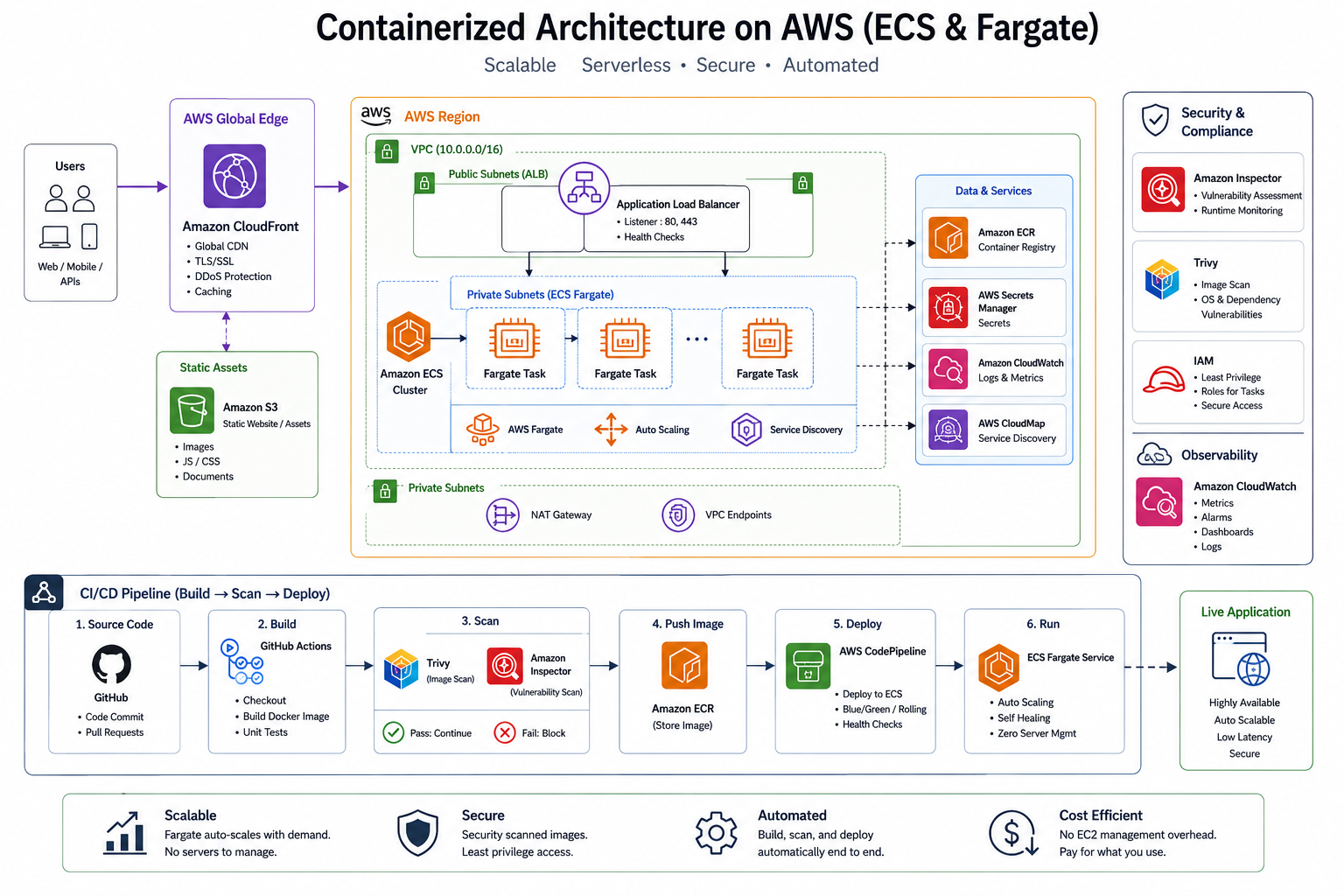
Designed a highly available AWS architecture fronted by CloudFront and Application Load Balancers, with application workloads running inside private subnets on Amazon ECS using AWS Fargate. Static assets were separated from application workloads and delivered through Amazon S3 and CloudFront to improve performance and reduce application load.
The platform leveraged containerized services running on ECS, allowing applications to scale independently while maintaining a consistent deployment model across environments. Supporting services such as Amazon ECR, Secrets Manager, CloudWatch, and Cloud Map provided secure image storage, secret management, observability, and service discovery — all designed around cloud-native principles with a strong emphasis on automation, security, and operational efficiency.
Platform modernization
Containerization strategy
A major objective was migrating application workloads to a container-based deployment model, delivering consistent runtime environments, simplified deployments, improved portability, faster release cycles, and reduced configuration drift. Containerization established a standardized platform for future application growth and modernization.
Serverless container infrastructure
Implemented AWS Fargate as the container execution layer to eliminate server management — no need to provision EC2 instances, patch operating systems, manage container hosts, or scale infrastructure manually. Engineering teams could focus on application delivery rather than infrastructure maintenance.
Security improvements
Identity & access management
Implemented a least-privilege access model across the platform: task-specific IAM roles, service-level permission boundaries, secure access to AWS services, and separation of application and administrative access — reducing the attack surface and improving security governance.
Secrets management
Centralized application secrets using AWS Secrets Manager. Applications retrieve credentials dynamically at runtime rather than storing sensitive information in source code repositories, container images, or environment configuration files — improving credential security while simplifying rotation and lifecycle management.
Container security
Integrated security validation into the application delivery process: container image scanning, vulnerability assessment, deployment gating for critical findings, and continuous security monitoring. Security became part of the deployment workflow rather than a separate post-deployment activity.
CI/CD automation
A major focus was building an automated deployment pipeline that takes application code from source control to production with minimal manual intervention:
Source Code → Build → Security Validation → Container Registry → Deployment → Production
Automation was implemented to build container images, execute validation checks, publish images to Amazon ECR, deploy updated services, and verify deployment health — significantly reducing deployment effort while improving release consistency and reliability.
Deployment strategy
Implemented deployment workflows supporting rolling deployments, health-based deployment validation, automated service updates, and safe rollout procedures — improving deployment confidence and reducing operational risk during releases.
Scalability & reliability
Auto scaling
Configured application services to scale dynamically based on workload demand, responding to CPU utilization, memory utilization, application traffic, and service demand. This kept performance consistent during traffic spikes while optimizing infrastructure cost during quieter periods.
High availability
The platform was designed to tolerate infrastructure and application failures through multiple application instances, load balancing, automated health checks, and self-healing container workloads. Failed tasks are automatically replaced, improving reliability and reducing operational intervention.
Service discovery
Implemented service discovery to simplify communication between distributed application components, improving scalability and reducing dependency on static configuration as the platform evolved.
Observability & monitoring
A major objective was improving operational visibility across the platform. Implemented centralized monitoring and logging using Amazon CloudWatch, ECS metrics, application logs, and infrastructure dashboards — providing visibility into application performance, service health, infrastructure utilization, deployment status, error rates, and operational alerts, and significantly improving incident detection and troubleshooting efficiency.
Alerting & operational visibility
Implemented monitoring dashboards and proactive alerting workflows so issues could be identified and addressed before impacting end users. Operational teams gained real-time visibility into platform health and performance, reducing mean time to detect and mean time to resolve production issues.
What I led
- Cloud architecture — AWS container-platform architecture, networking and deployment patterns, scalable infrastructure foundations.
- Platform engineering — ECS and Fargate workload orchestration, standardized container deployment workflows, improved scalability and maintainability.
- Security engineering — least-privilege IAM controls, integrated secrets management, security validation embedded into deployment workflows.
- DevOps automation — automated CI/CD pipelines, standardized application delivery, reduced manual deployment effort.
- Observability — monitoring and logging solutions, operational dashboards and alerts, improved platform visibility and incident response.
Outcome
Delivered a secure, scalable, and operationally efficient container platform capable of supporting production workloads without traditional server management. Key outcomes:
- Automated application deployment workflows.
- Improved deployment consistency and reliability.
- Reduced infrastructure management overhead through AWS Fargate.
- Stronger security through IAM controls and centralized secrets management.
- Enhanced observability across applications and infrastructure.
- Automatic scaling based on workload demand.
- Improved resilience through self-healing workloads and health-based routing.
- A modern cloud-native foundation capable of supporting future application growth.
The project transformed the application environment from a traditionally managed deployment model into a scalable, automated, and cloud-native platform built around containerization, security, and operational excellence.
← Back to all projects